The Gardener and the Carpenter: What the New Science of Child Development Tells Us About the Relationship Between Parents and Children by Alison Gopnik
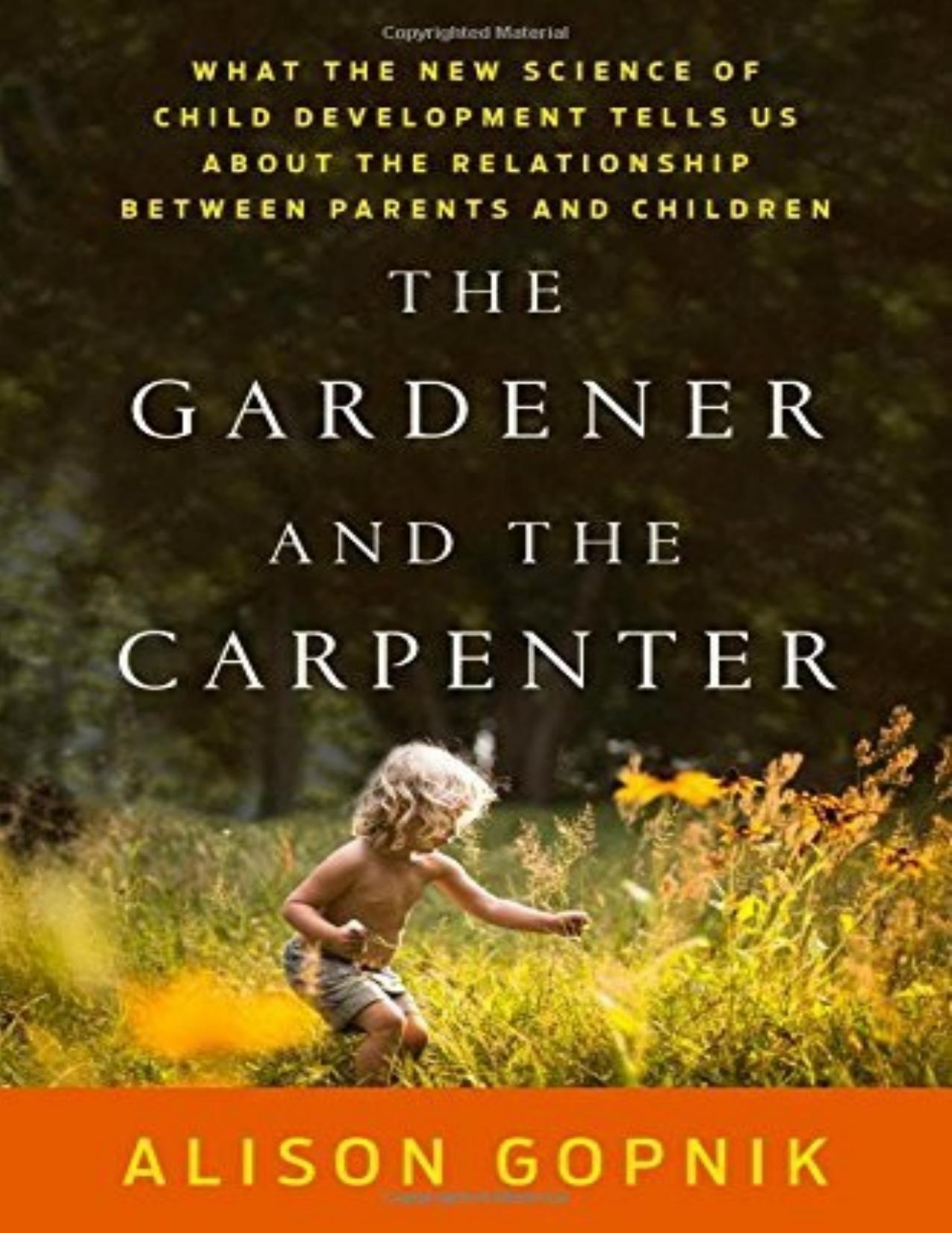
Author:Alison Gopnik
Language: eng
Format: epub, pdf
ISBN: 9781429944335
Publisher: Farrar, Straus and Giroux
Pop-Beads and Popper
Recently, Laura Schulz and her students at MIT have done some fascinating studies that examine how young humans master our equivalent of pandanus palms—namely, the many technological gadgets that surround us. When you leave a preschooler alone with an interesting new gadget, it’s no surprise that they play with it. What may be surprising, however, is that they play in a way that’s structured to give them just the information they need to figure out how that gadget works. For these children, play is, literally, experimentation.
In one study, for example, the experimenters gave four-year-olds one of our blicket detectors—that box that lights up and plays music when you put certain things on top of it. Instead of putting blocks on the machine, though, they used Pop-Beads, the kind of toy plastic beads that you can stick together or pull apart.
First, the experimenter showed the children that only some separate, individual beads made the toy go and not others. Then she gave them a new set of beads that were stuck together, and left them alone to play. The children carefully pulled the beads apart and tested them individually on the machine. When the experimenter sneakily glued the beads together, the children ingeniously tipped one end of the glued pair on the machine and then flipped it to try the other end, so that they could discover the effect of each bead separately.
In another version of the study, all the beads made the machine go. Now when the experimenter gave the children the stuck-together beads and let them play, they were much less likely to pull the beads apart. Instead, they just put the attached beads on the machine together. They seemed to realize that, in this case, pulling the beads apart wouldn’t tell you anything new.
In another experiment, the researchers gave slightly older children a balance beam to explore. It was the kind of seesaw scale that balances on a fulcrum, and you can add a heavy weight to one end or the other. It turns out that six-year-olds have an inaccurate but intelligent theory of how balance beams work. They think that if the fulcrum is at the center of the beam, it will balance, no matter how heavy the weights are at each end.
By around seven or eight, the children start to develop a more accurate theory of mass. They recognize that the balance point depends on how heavy the ends of the beam are. If you add a heavy block to one end, you will have to move the fulcrum toward that end to get the beam to balance.
The researchers used a magnet to design trick beams that balanced at the center when the weights were uneven, or balanced to one side even when they were not. They checked to see whether children were center or mass theorists, and then left the kids alone with the trick balance beam and a new toy.
The “center theory” children played more with the beam when the balance was off-center—in other words, when the data contradicted their theory.
Download
The Gardener and the Carpenter: What the New Science of Child Development Tells Us About the Relationship Between Parents and Children by Alison Gopnik.pdf
This site does not store any files on its server. We only index and link to content provided by other sites. Please contact the content providers to delete copyright contents if any and email us, we'll remove relevant links or contents immediately.
The Lost Art of Listening by Michael P. Nichols(7622)
Rich Dad Poor Dad by Robert T. Kiyosaki(6855)
We Need to Talk by Celeste Headlee(5727)
I Love You But I Don't Trust You by Mira Kirshenbaum(3964)
The Complete Idiot's Guide to Coping With Difficult People by Arlene Uhl(3216)
Rich Dad Poor Dad: What The Rich Teach Their Kids About Money - That The Poor And Middle Class Do Not! by Robert T. Kiyosaki(3041)
A Burst of Light by Audre Lorde(2687)
The Book You Wish Your Parents Had Read (and Your Children Will Be Glad That You Did) by Philippa Perry(2605)
Dealing with People You Can't Stand by Dr. Rick Brinkman(2521)
Life Hacks by Dan Marshall(2516)
An Odyssey by Daniel Mendelsohn(2371)
The Expectant Father by Armin A. Brott & Jennifer Ash(2335)
Teach Your Child How to Think by Edward De Bono(2217)
The Anxious Generation by Jonathan Haidt(2211)
No Time to Say Goodbye(2176)
The 7 Habits Of Highly Effective Teens by Covey Sean(2142)
What I Need by J. Daniels(2141)
The Out-of-Sync Child by Carol Stock Kranowitz(2101)
I Don't Belong to You by Keke Palmer(2064)
